
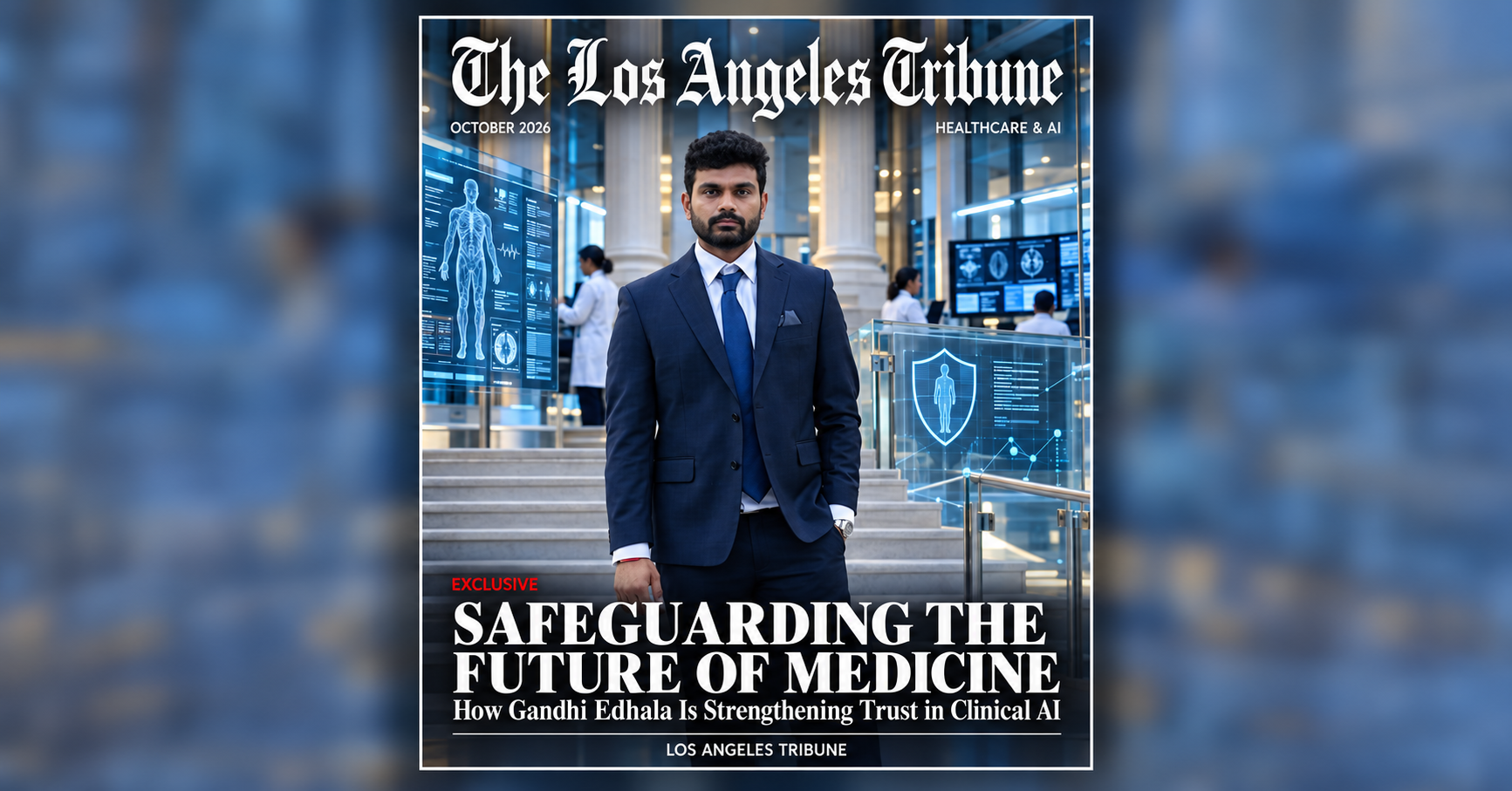
How Gandhi Edhala Is Strengthening Trust in Clinical AI
As AI moves from research labs into hospitals and other care settings, a central engineering challenge is coming into focus: how can increasingly autonomous systems be deployed without compromising safety, security, or human oversight?
The question is no longer only whether AI can analyze medical data or predict clinical outcomes. It is also whether the systems around it can protect patient information, enforce policies, detect failures, and give clinicians meaningful insight into—and control over—automated actions.
Gandhi Edhala, Senior Analytics Engineer at Bamboo Health, works where advanced data systems, cybersecurity, and agentic AI converge.
His research and engineering explored how to build stronger safeguards into autonomous AI while developing the data infrastructure needed to support healthcare applications on a scale.
Defining Safer Boundaries for Clinical AI
One focus of Edhala’s work is how autonomous AI behaves within clinical workflows.
Unlike systems that generate a single prediction or response, agentic AI can execute a sequence of actions. In healthcare, this capability creates additional engineering demands because those actions may affect sensitive data, clinical processes, or time-critical workflows.
Edhala’s research includes “Provably Safe Action Spaces for Agentic AI in Time-Critical Clinical Workflows” and “Fail-Safe Autonomy: Detecting and Preventing Silent Failures in Clinical Agentic AI.”
These studies explore how to establish safe operating limits and detect failures that could otherwise go unnoticed during autonomous operation.
This work also applies formal verification. Instead of evaluating only an AI system’s output, formal methods can test whether its behavior complies with specified rules and constraints.
For clinical use, this supports a different deployment model—one in which autonomous capabilities are paired with monitoring, verification, traceability, and control.
Securing the Data That Powers Medical AI
Clinical AI is only as reliable as the systems that collect, transmit, store, and process healthcare data.
Healthcare environments span distributed applications, cloud platforms, edge devices, APIs, and varied user groups. Protecting information across this ecosystem requires more than securing a single application or database.
Edhala’s work addresses this broader infrastructure.
His research, “Zero-Trust Meets Explainable AI: A Conceptual Architecture for Secure Edge-to-Cloud Healthcare Systems,” examines how zero-trust security and explainable AI can be integrated across healthcare environments, from edge systems to cloud infrastructure.
The approach addresses two related needs: restricting access to sensitive systems and making AI-supported processes understandable to those responsible for them.
He also studies resilient architecture that remain operational when parts of a distributed environment fail or are disrupted.
In healthcare, resilience is closely tied to availability. A secure system that fails during a critical operation creates its own operational risk, making both security and continuity essential design priorities.
Linking AI Research into Patient Safety
Edhala’s research also explores how digital technologies can improve patient safety and healthcare operations.
His contributions to forthcoming IGI Global Scientific Publishing work address artificial intelligence, patient safety, and digital innovation in smart nursing practices.
These efforts reflect a broader research goal: understanding not only how AI models work but also how intelligent technologies can be introduced into real healthcare settings while keeping innovation aligned with operational safety.
This distinction matters increasingly as healthcare organizations adopt AI for clinical analytics, workflow automation, patient monitoring, and decision support.
Turning Research into Intellectual Property
Edhala’s work extends from research publications to intellectual-property development.
In the United States, he has filed a patent application for an AI-Based Healthcare Data Integrity Monitoring System, a technology designed to monitor the integrity of healthcare information used by AI-enabled systems.
Data integrity is essential to clinical AI. Altered, corrupted, incomplete, or otherwise unreliable information can lead an AI system to generate results from inaccurate inputs.
Edhala has also registered a UK design for a user interface that monitors and controls AI safety functions.
The interface is designed to help healthcare personnel observe and manage AI safety features during operation.
Together, these projects highlight two complementary dimensions of AI engineering: securing the underlying information infrastructure and creating interfaces that enable people to supervise and interact with intelligent systems.
Contributing to the Research Community
Edhala also contributes to research evaluation and technical program activities.
He serves on the Technical Program Committee for the IEEE International Conference on Communication Systems and Network Technologies and has peer-reviewed work for publications including Knowledge-Based Systems and Springer Nature journals.
He also serves on the IEEE Senior Member Application Review Panel, helping evaluate engineers seeking IEEE Senior Member status.
He is also scheduled to share his technical expertise at the AI-Data X 2026 Conference in Tokyo, Japan.
These roles connect his work to a broader professional network of research publication, technical review, professional evaluation, and knowledge exchange.
Building a More Dependable Foundation for Healthcare AI
Healthcare’s growing use of AI presents a systems-engineering challenge that goes far beyond model development.
AI may eventually support increasingly complex tasks, but successful deployment depends on the surrounding infrastructure: secure data, reliable networks, controlled access, resilient architecture, effective monitoring, and interfaces that let people understand and oversee automated processes. This is especially critical for digital patient models, predictive clinical systems, and agentic AI, which can process vast amounts of data and execute multistep workflows.
Edhala tackles these challenges across connected disciplines, including healthcare data integrity, zero-trust security, explainable AI, formal verification, resilient system architecture, and human oversight of autonomous systems.
The common goal is to build safeguards around AI rather than view the model as a stand-alone component.
As healthcare organizations adopt more autonomous technologies, supporting infrastructure will become increasingly important to their safe deployment and oversight.
At the intersection of healthcare data, cybersecurity, artificial intelligence, and dependable computing, Gandhi Edhala’s work addresses a central question in digital medicine: how can increasingly capable AI systems operate within clear, verifiable, and secure boundaries.




Be First to Comment