
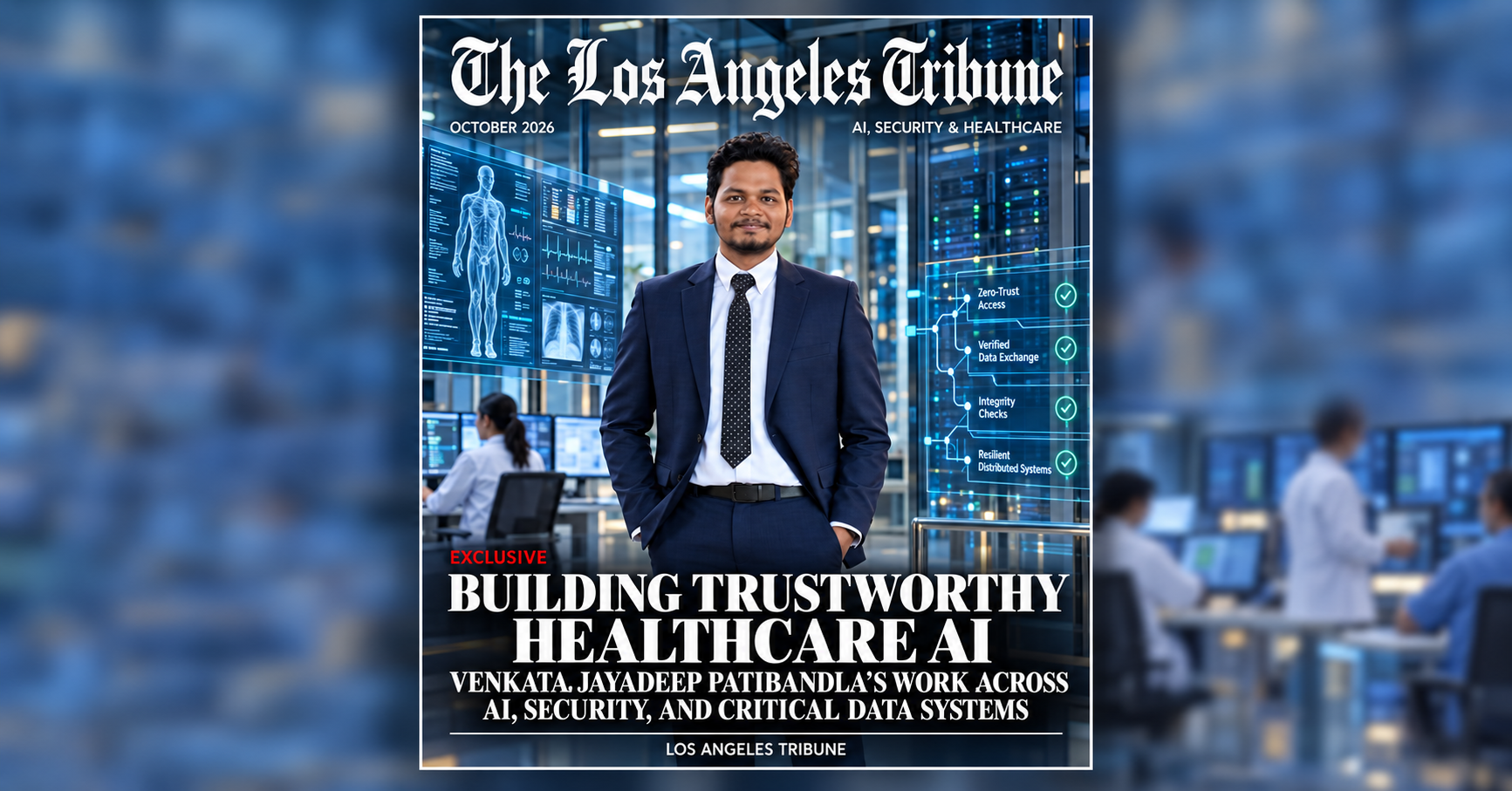
Engineering Trust into the Next Generation of Intelligent Systems
Artificial intelligence is moving from experimentation into settings where its outputs can shape healthcare operations, financial activity, cybersecurity decisions, and other data-intensive processes.
As these systems gain autonomy, accuracy alone is not enough. They must operate within defined security boundaries, protect sensitive data, verify identities and permissions, preserve data integrity, and support review and control of automated actions.
Venkata Jayadeep Patibandla’s research addresses this challenge across artificial intelligence, cybersecurity, formal verification, healthcare data systems, distributed analytics, and dependable computing.
His eight published papers examine secure clinical AI agents, healthcare data platforms, distributed analytics, cloud-based predictive analytics, and financial forecasting. A consistent theme is how autonomous systems can remain subject to verifiable security and reliability controls.
Securing Autonomous AI in Clinical Settings
Healthcare is among the most demanding settings for autonomous AI. These systems may handle sensitive patient data and participate in workflows where unauthorized actions, errors, or failures can have serious consequences.
Patibandla’s recent work approaches this problem through system architecture and security controls.
His 2026 paper, “Zero-Trust Autonomy: Cryptographically Enforced Safety and Policy Compliance in Clinical AI Agents,” explores how zero-trust principles and cryptographic mechanisms can secure clinical AI agents.
The central challenge is simple to state but difficult to implement: an autonomous system must perform useful tasks while remaining constrained by identity, authorization, security, and policy requirements.
Related studies include “Provably Safe Action Spaces for Agentic AI in Time-Critical Clinical Workflows” and “Non-Repudiable Guardrails for Agentic AI: Formal Verification Framework for Autonomous Clinical Intervention.”
These papers examine complementary ways to constrain autonomous AI, including predefined action spaces, formal verification, and stronger assurance mechanisms for system actions.
Rather than treating autonomy as unrestricted, this work frames it as a controlled systems-engineering problem in which permitted actions can be defined, assessed, and verified.
Building Trust into Healthcare Data Platforms
AI systems ultimately depend on the integrity and availability of the data around them.
Healthcare data platforms may connect many applications, APIs, distributed services, users, and analytics systems. As these environments grow, maintaining trust among components becomes both an architectural and cybersecurity challenge.
Patibandla’s paper “A Multi-Layer Trust Verification Model for Large-Scale Healthcare Data Platforms” investigates how trust can be established and validated across large healthcare data environments.
His study “Formal Verification of Data Integrity and API Security in Distributed Analytics Systems” explores the connections among data integrity, API security, and distributed analytical processing.
Another paper, “Resilience-Aware Architectural Modeling for Mission-Critical Healthcare Data Systems,” focuses on reliability in healthcare systems where service interruptions can limit access to critical information.
Together, these projects address the infrastructure beneath healthcare applications: protecting data, verifying interactions, preserving system integrity, and sustaining service continuity.
From Research Concepts to Intellectual Property
Patibandla’s work extends beyond academic publishing into intellectual-property development.
In the United States, he is named as an inventor on the patent application “Trust Verification Framework for Secure Healthcare Data Exchange.” The technology covers hardware-based trust verification, identity validation, encryption, integrity checks, transaction ordering, policy enforcement, and secure trust storage.
The concept establishes a framework for applying multiple layers of trust and security verification to healthcare data exchanges.
His intellectual-property work also reaches Europe.
A German utility-model application covers an “Adaptive Fault-Tolerant System Architecture for Uninterrupted Availability of Safety-Critical Medical Data Processing Systems.” It describes an architecture designed to maintain availability when components fail or operations are disrupted.
In the United Kingdom, Patibandla owns the registered design “Graphical Interface for Digital Patient-Twin Simulation and AI Decision Validation.”
The design reflects another strand of his research: using digital patient representations and simulation interfaces to test and validate AI-driven decisions.
Together, his publications and intellectual-property activities show an approach that connects theoretical frameworks, system architecture, and protected technological implementations.
Evaluating Research Through Peer Review
Patibandla has also reviewed scientific work in artificial intelligence and dependable computing.
In 2026, a Springer Nature certificate documented his reviews of three manuscripts submitted to Discover Artificial Intelligence.
The manuscripts covered machine learning for image recognition, attacks on AI systems used in high-frequency trading, and AI governance and ethics.
He has also reviewed three manuscripts for IEEE Transactions on Dependable and Secure Computing.
Those reviews addressed Spectre attacks, secure hardware-software co-design, and multi-agent techniques for detecting previously unknown web-attack threats.
Peer reviewers assess work submitted by other researchers, considering methodology, technical validity, evidence, originality, and scientific contribution.
This role complements Patibandla’s publication record: he contributes to the research process both by producing technical studies and by evaluating the work of others.
Extending the Research into Cloud and Financial Analytics
Although healthcare and trustworthy AI are central to Patibandla’s recent work, his interests span several related computing fields.
His research includes cloud-based predictive analytics for postoperative risk assessment and a 2025 study of scalable AutoML for financial prediction in multi-tenant cloud platforms serving small and medium-sized businesses.
These projects share several themes with his healthcare research.
They combine large-scale data processing, machine learning, distributed computing, and cloud infrastructure with the need to preserve reliability and measurable performance across many users and services.
What links these fields is the infrastructure around AI. Whether applied to healthcare, financial forecasting, or cybersecurity, intelligent systems need dependable data pipelines, secure interfaces, controlled access, and architectures that can adapt to changing conditions.
Making AI More Verifiable and Dependable
As AI systems become more autonomous, engineering priorities are expanding beyond model performance.
In sensitive settings, the supporting infrastructure must address additional questions.
Who may invoke an AI system? Which actions may it take? Can the underlying data be verified? Can automated decisions be reviewed afterward? What happens when a component fails? And can security and policy requirements remain enforced during operation?
Patibandla addresses these questions through interconnected work on zero-trust clinical AI, formally verified safety mechanisms, healthcare data trust models, API security, resilient architectures, distributed analytics, and digital patient simulation.
His publications, intellectual-property activities, and peer-review work together define a research agenda focused on the security, verification, and dependability of intelligent, data-intensive systems.
As AI becomes more deeply embedded in healthcare, financial services, cybersecurity, and other critical digital environments, the surrounding systems will increasingly determine whether autonomous capabilities can be deployed with appropriate safeguards.
Patibandla’s work focuses on this infrastructure layer—where AI intersects with cybersecurity, healthcare technology, distributed systems, and dependable computing—and on the engineering mechanisms needed to make autonomous systems more secure, verifiable, and resilient.





Be First to Comment